
Your company manufactures or supplies technically advanced industrial equipment. Your catalog contains hundreds of products, each with detailed specifications, performance ratings, dimensions, and application requirements.
But when a procurement manager visits your website to find a particular component, they’re greeted with a familiar instruction:
“Download Our Product Catalog (PDF).”
The document is 180 pages long.
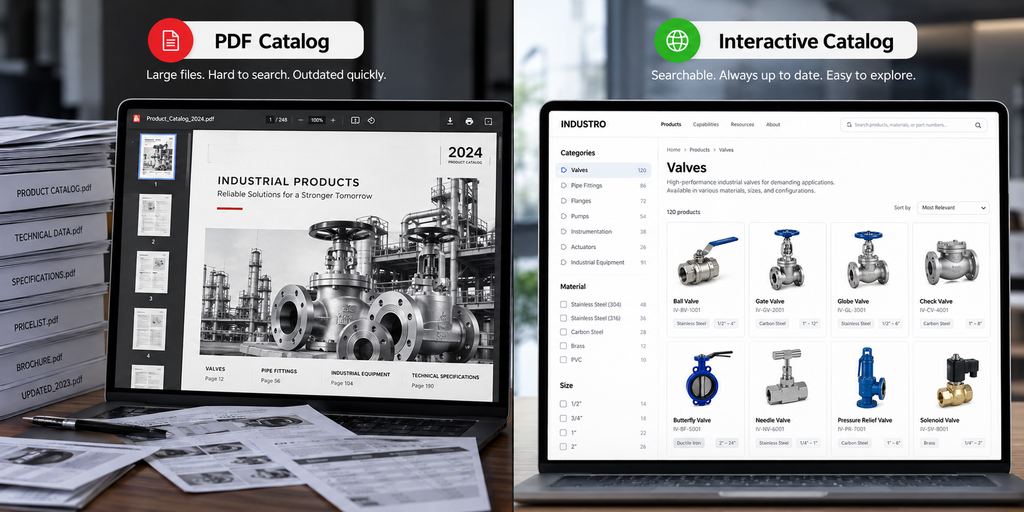
Finding the correct product means downloading the file, searching through unfamiliar model numbers, examining dense specification tables, and manually comparing options.
On a mobile device, the experience becomes even more frustrating.
Meanwhile, a competing supplier offers a searchable online catalog where buyers can filter products by capacity, operating pressure, dimensions, materials, and technical compatibility.
Within minutes, the buyer identifies a suitable model, reviews its specifications, and submits a quotation request.
Both suppliers might offer comparable equipment. But one has made the purchasing process significantly easier.
For industrial equipment suppliers and custom manufacturers, the problem isn’t the PDF format itself. It’s relying on static documents as the primary way buyers discover, evaluate, and compare products.
Modern industrial websites should make technical information accessible, searchable, and immediately useful.
Why Traditional PDF Catalogs Create Friction for Industrial Buyers
PDF catalogs have served manufacturers and technical equipment suppliers for decades.
They’re familiar, easy to distribute, and useful for preserving detailed engineering documentation.
However, problems emerge when a PDF becomes the only meaningful source of product information on a company’s website.
1. Finding Specific Products Takes Too Much Effort
Imagine a mechanical engineer searching for an industrial pump capable of handling a particular flow rate and operating pressure.
The supplier offers 120 pump models across several product families.
Instead of filtering by technical requirements, the engineer must download a catalog and search manually.
Even when the document contains searchable text, the buyer may need to jump between pages to compare performance ratings, connection sizes, and operating conditions.
This creates unnecessary work before the supplier can even be shortlisted.
2. Comparing Technical Specifications Is Difficult
Industrial procurement often requires comparing multiple products against predefined engineering requirements.
A buyer evaluating commercial refrigeration compressors, for example, might need to compare cooling capacity, refrigerant compatibility, electrical requirements, operating temperature, and physical dimensions.
When specifications are scattered across different PDF pages, comparing models becomes cumbersome.
Engineers may resort to copying information into spreadsheets.
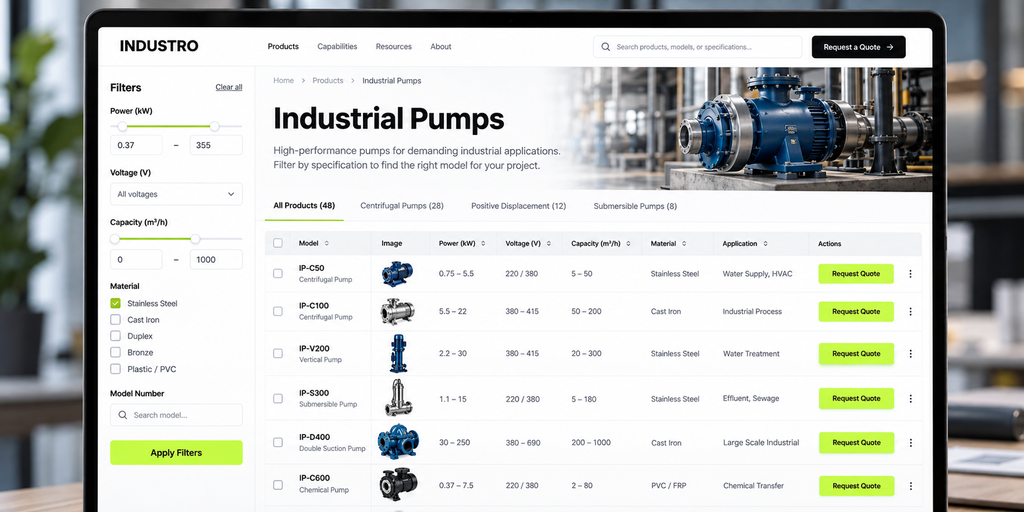
An interactive online catalog can eliminate much of this manual comparison.
3. Mobile Access Is Often Poor
Procurement professionals don’t always review equipment from desktop computers.
Plant engineers may access technical information from production floors. Maintenance managers might check replacement component specifications while inspecting equipment on-site.
A large PDF with fixed-width tables and technical diagrams can be difficult to navigate on a phone.
Users may need to zoom, scroll horizontally, and repeatedly reposition the document.
A responsive product page can present the same information in a layout designed for the user’s screen.
4. Catalog Updates Become Harder to Manage
Industrial product specifications change.
Manufacturers introduce new models, discontinue components, update technical data, and revise product compatibility information.
With static catalogs, maintaining accurate information may involve editing the original document, exporting another PDF, uploading it, and replacing outdated links.
Copies downloaded by customers may remain in circulation long after a specification has changed.
A centralized online product database makes updates easier to manage and can display revision dates or document versions where appropriate.
It doesn’t eliminate the need for technical data governance, but it reduces reliance on distributing new catalog files for every change.
What an Interactive Industrial Product Catalog Should Look Like
An interactive catalog isn’t necessarily an e-commerce store.
Many industrial equipment suppliers operate through RFQs, negotiated pricing, authorized distributors, or application-specific quotations.
The goal is to help technical buyers identify suitable products and take the next commercial step.
A properly designed industrial catalog should offer three core capabilities.
Searchable Product Information
Buyers should be able to search using product names, model numbers, part numbers, technical descriptions, and relevant application terms.
For example, someone searching for a specific hydraulic cylinder model should reach the relevant product page without manually navigating several product categories.
Search functionality should also account for common naming variations and part-number formatting where possible.
Filterable Technical Specifications
Technical filters should reflect the criteria buyers actually use when selecting products.
For industrial pumps, these could include:
- Flow rate and operating pressure
- Power requirements
- Fluid compatibility
- Connection size
- Material construction
- Operating temperature
For precision-machined components, filters might focus on material, dimensions, tolerances, finishing options, and supported manufacturing processes.
These fields should be based on meaningful technical parameters rather than generic categories such as “Featured” or “Popular.”
Side-by-Side Product Comparison
Buyers should be able to select several models and compare their specifications within one interface.
A comparison table makes it easier to identify which product meets the required performance, dimensional, and compatibility constraints.
This is particularly useful when different models share similar descriptions but differ in critical operating characteristics.
The objective is straightforward: make it easier for buyers to move from a technical requirement to a suitable product.
Interactive Specification Tables Improve the Procurement Experience
A well-designed specification table can be one of the most valuable features on an industrial product website.
Consider a supplier offering electric motors for industrial machinery.
Instead of forcing buyers to inspect several PDF pages, its website could provide a searchable technical table.
| Model | Power | Voltage | Speed | Efficiency Class |
|---|---|---|---|---|
| IM-075 | 7.5 kW | 400 V | 1,460 rpm | IE3 |
| IM-110 | 11 kW | 400 V | 1,470 rpm | IE3 |
| IM-150 | 15 kW | 400 V | 1,475 rpm | IE4 |
| IM-220 | 22 kW | 400 V | 1,480 rpm | IE4 |
Illustrative specifications only; not actual manufacturer product data.
A buyer could filter by power output, sort by motor efficiency, and select models for comparison.
Each model could also link to a dedicated product page containing dimensional drawings, mounting information, performance curves, compatible accessories, and a quotation button.
For complex technical tables, the mobile version might use horizontal scrolling with clear column labels or an accessible stacked presentation that preserves the relationship between specifications and values.
This gives procurement professionals a more efficient way to gather the information they need for internal technical review.
It also allows equipment suppliers to connect product discovery directly with commercial enquiries.
How Interactive Product Catalogs Improve Technical SEO
The commercial value of interactive catalogs extends beyond usability.
They can also create a stronger foundation for attracting relevant search traffic.
1. Individual Product Pages Target Specific Searches
Industrial buyers frequently search for exact specifications, model numbers, materials, and equipment applications.
Consider the difference between these searches:
“Industrial electric motors”
“15kW IE4 three-phase industrial motor”
The second search indicates a much more specific requirement.
When product information exists only inside a lengthy PDF, the supplier has fewer opportunities to organize dedicated HTML pages around individual products and their applications.
A structured catalog can provide descriptive URLs, unique page titles, technical headings, product specifications, and relevant internal links.
This helps search engines and buyers understand what each page offers.
2. HTML Content Supports Better Site Architecture
An industrial website might organize its products as follows:
Products → Electric Motors → Three-Phase Motors → 15kW IE4 Motor
This structure allows search engines to discover relationships between categories, product families, and individual models.
It also provides buyers with clear navigation between related equipment.
Product pages can link to compatible accessories, technical support information, application guides, and RFQ forms.
However, technical information should be available in crawlable HTML rather than appearing exclusively inside a JavaScript widget that requires user interaction.
3. Structured Data Adds Product Context
Where appropriate, industrial product pages can use Product structured data to describe information such as product identifiers, manufacturers, and supported product details.
For qualifying pages, Google’s product structured data systems may support additional search result features.
Eligibility depends on the type of page, the accuracy of the markup, and Google’s applicable requirements. Adding schema doesn’t guarantee rich results or higher rankings.
4. Technical Search Visibility Creates Better Commercial Opportunities
An industrial supplier may not need thousands of broad website visits.
It may benefit more from a smaller number of visitors searching for very specific equipment.
A procurement manager looking for a replacement pump with defined operating characteristics is potentially more relevant than someone casually browsing industrial equipment.
By creating dedicated, technically accurate product pages, suppliers can address specific search requirements and make it easier for qualified buyers to find suitable equipment.
The objective isn’t simply increasing traffic.
It’s helping the right buyers discover the right products at the moment they’re evaluating suppliers.
Should Industrial Suppliers Eliminate PDFs Completely?
No.
PDFs remain valuable for formal datasheets, installation manuals, engineering drawings, certification documents, and downloadable technical references.
Some procurement teams also require documents that can be saved, circulated internally, or included in formal purchasing records.
The better approach is to make HTML product pages the primary discovery and comparison experience, while retaining PDFs as supporting documentation.
For example, an industrial compressor page could provide searchable specifications, performance characteristics, model comparisons, and an RFQ button.
Below that information, buyers could download the official technical datasheet, installation manual, or dimensional drawing.
This combines the convenience of interactive browsing with the reliability of manufacturer-controlled technical documentation.
How to Modernize an Existing Industrial Product Catalog
Moving away from a PDF-first website doesn’t necessarily require manually rebuilding hundreds of product pages.
A structured migration process can make the transition more manageable.
Step 1: Audit the existing catalog. Identify product families, model numbers, technical attributes, outdated documents, and frequently requested specifications.
Step 2: Create a centralized product data structure. Organize specifications using consistent field names, units, product identifiers, and revision controls.
Step 3: Build searchable product and category pages. Develop responsive templates with filters, comparison functionality, technical documentation, and clear enquiry options.
Step 4: Implement technical SEO. Configure descriptive URLs, internal links, indexable content, relevant structured data, and appropriate canonical handling for filter-generated URLs.
Step 5: Connect product discovery to enquiries. Allow buyers to request quotations with the selected model, quantity, and technical requirements already attached to the enquiry.
The result is a website that supports product discovery, technical evaluation, and commercial engagement rather than functioning as a basic document library.
Your Catalog Should Help Buyers Make Decisions, Not Create More Work
Industrial equipment suppliers invest considerable resources in engineering, product development, testing, quality assurance, and technical documentation.
That expertise deserves to be presented in a way buyers can actually use.
A bulky PDF catalog may contain every specification a procurement manager needs, but information has limited commercial value when finding and comparing it requires unnecessary effort.
Interactive product catalogs make technical information easier to search, filter, compare, and access across devices.
They also create opportunities for stronger technical SEO and more direct connections between product evaluation and RFQ submissions.
The goal isn’t to replace detailed engineering documentation.
It’s to make that documentation part of a more efficient digital buying experience.
Turn Your Industrial Product Catalog Into a Better Sales Tool
At Cruxe Studio, we design and optimize websites for industrial, engineering, and commercial service businesses.
From custom website architecture and searchable product catalogs to technical SEO and structured enquiry experiences, our focus is on helping businesses present their capabilities clearly and connect with qualified commercial buyers.
If your website still relies on lengthy PDF catalogs to communicate essential product information, there may be a better way to organize your digital presence.