
Your manufacturing facility might operate millions of dollars’ worth of machinery, employ highly skilled engineers, and deliver precision components for demanding industries. Yet, when a procurement manager visits your website, they encounter an outdated design, a downloadable PDF quotation form, and a generic contact page.
That disconnect could be costing your business valuable contracts.
In industrial manufacturing, a website isn’t simply a digital company brochure. It’s often the first point of technical evaluation for prospective buyers. Before contacting your sales team, procurement managers and engineering directors need to establish whether your company has the equipment, expertise, capacity, and certifications to deliver their project.
If your website makes that evaluation difficult, qualified buyers may move on to another supplier.
For manufacturers pursuing contracts worth $100,000 or more, even a small number of missed opportunities can have significant commercial consequences.
The problem isn’t necessarily your manufacturing capabilities. It’s the gap between what your business can deliver and how effectively your website communicates those capabilities.
Here’s where traditional manufacturing websites lose potential RFQs and how to build a stronger quotation pipeline.
Your Website Is Part of the Supplier Evaluation Process
Industrial procurement is fundamentally different from consumer purchasing.
A procurement manager sourcing precision-machined components isn’t looking for the most visually impressive website. They’re evaluating potential suppliers against technical, operational, and commercial requirements.
They want answers to questions such as:
- Can this manufacturer achieve the required machining tolerances?
- Does the facility support the necessary materials and production volumes?
- Are relevant ISO certifications and quality assurance procedures in place?
- Can the supplier accommodate the expected production schedule?
- How quickly can the engineering team review drawings and provide a quotation?
Your website should make these answers accessible without requiring multiple phone calls or emails.
Consider two precision engineering companies competing for the same project.
Company A has an outdated website featuring generic service descriptions, a few equipment photographs, and a contact form requesting a name, email address, and message.
Company B has dedicated capability pages detailing its CNC equipment, machining tolerances, supported materials, inspection processes, and production capacity. Its RFQ form allows buyers to upload drawings and submit project specifications directly.
Even if both manufacturers possess similar capabilities, Company B has made it easier for a buyer to establish technical suitability and initiate procurement.
That advantage matters when buyers are narrowing a supplier shortlist.
Where Traditional Manufacturing Websites Lose High-Value RFQs
1. Static PDF Forms Create Unnecessary Procurement Friction
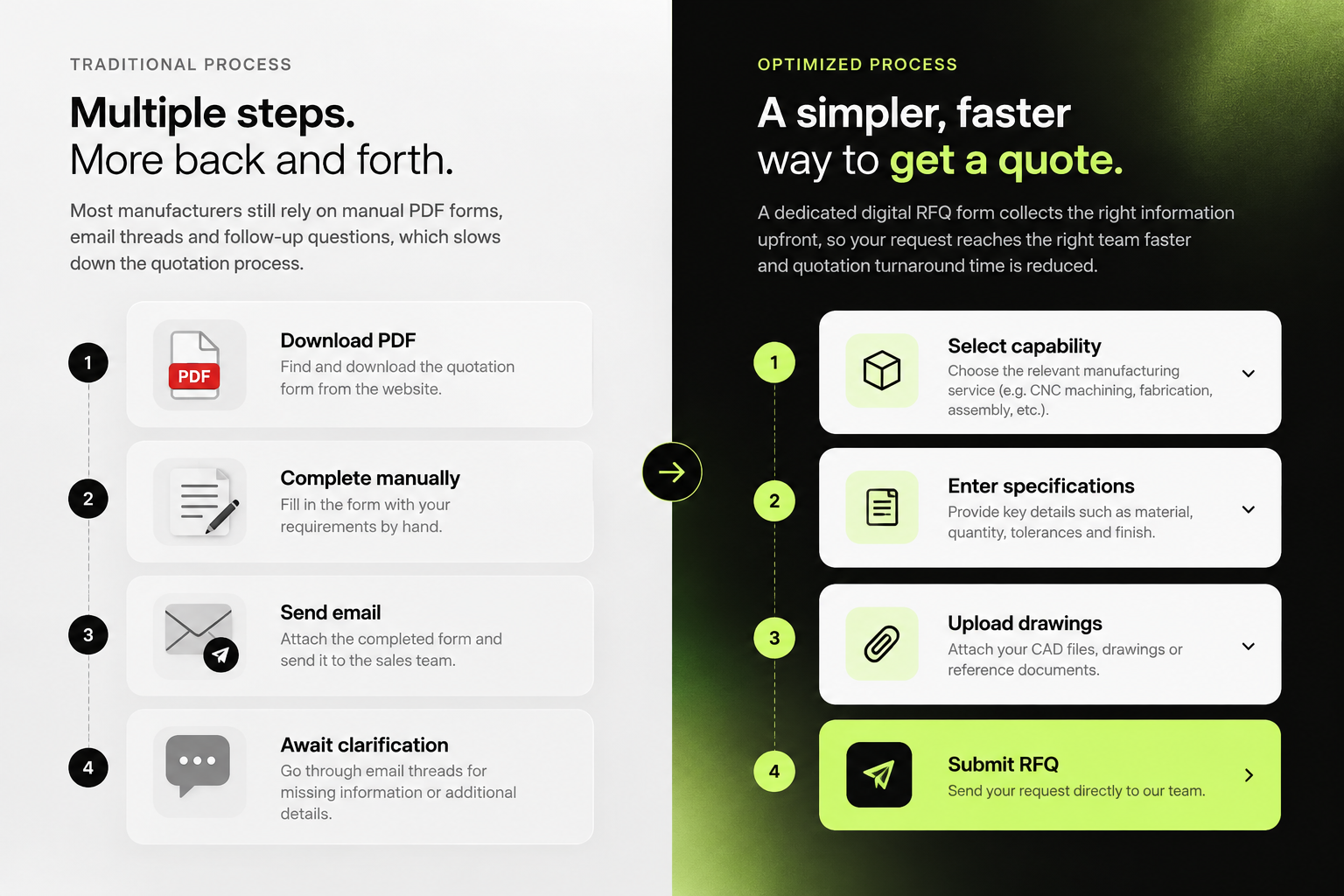
Many manufacturing websites still require prospective customers to download a PDF, complete it manually, and email it back with their project details.
Although this process may appear straightforward internally, it introduces unnecessary steps for prospective buyers.
A procurement manager must download the document, open a compatible application, complete the required fields, locate the appropriate email address, attach technical files, and send everything manually.
Every additional step creates another opportunity for the process to stall.
PDF forms also introduce operational inefficiencies. Information may arrive incomplete, drawings can become separated from quotation requests, and sales teams may spend additional time clarifying basic specifications.
A well-designed digital RFQ system removes much of this friction.
Instead of downloading documents, buyers can submit project requirements directly through your website, including technical drawings, materials, quantities, and expected delivery dates.
The objective isn’t to eliminate technical evaluation. It’s to make initiating that evaluation easier.
2. Slow Website Performance Undermines the Buying Experience
Manufacturing websites frequently contain large equipment photographs, product catalogs, technical documents, and resource-heavy design elements.
Without proper optimization, these assets can significantly affect website performance.
A slow-loading website creates problems before a prospective customer even evaluates your capabilities.
Technical buyers may be accessing supplier websites from offices, factory floors, or mobile devices. If critical information takes too long to appear, navigating your services becomes frustrating.
Google’s Core Web Vitals guidelines recommend achieving a Largest Contentful Paint (LCP) of 2.5 seconds or less for a good loading experience. Google’s recommended Interaction to Next Paint (INP) threshold is 200 milliseconds or less, reflecting how quickly a website responds to interactions. Google for Developers
While these metrics don’t independently determine whether an industrial buyer submits an RFQ, they provide useful benchmarks for identifying technical performance problems.
Manufacturing websites should prioritize fast-loading service pages, properly optimized equipment imagery, responsive layouts, and reliable quotation forms.
A website that communicates operational reliability should also function reliably.
3. Generic Contact Forms Fail to Capture Technical Requirements
A contact form asking for someone’s name, email address, and a short message might be adequate for a general enquiry.
It isn’t particularly effective for complex manufacturing projects.
Consider an aerospace component manufacturer receiving a message that simply states:
“We need a quotation for 500 aluminum components.”
The engineering team still needs to determine the required material grade, dimensions, tolerances, surface finish, delivery schedule, and inspection requirements.
This creates unnecessary communication before meaningful quotation work can begin.
A properly structured RFQ system should collect enough information to support initial technical evaluation without overwhelming the buyer.
Relevant fields might include material specifications, quantities, manufacturing processes, required certifications, target delivery dates, and secure drawing uploads.
The NIST Manufacturing Extension Partnership’s supplier scouting process illustrates the value of structured technical intake. Its supplier information requirements include manufacturing processes, dimensions, tolerances, specifications, certifications, business requirements, and supporting technical documents.
3 Steps to Build a Higher-Converting Manufacturing RFQ Pipeline
Fixing your quotation pipeline doesn’t necessarily require rebuilding your entire digital infrastructure.
It requires identifying where prospective buyers encounter friction and improving the processes that connect enquiries to your engineering and commercial teams.
Step 1: Replace Generic Contact Forms With a Technical RFQ Portal
Your RFQ form should reflect how industrial buyers actually submit project requirements.
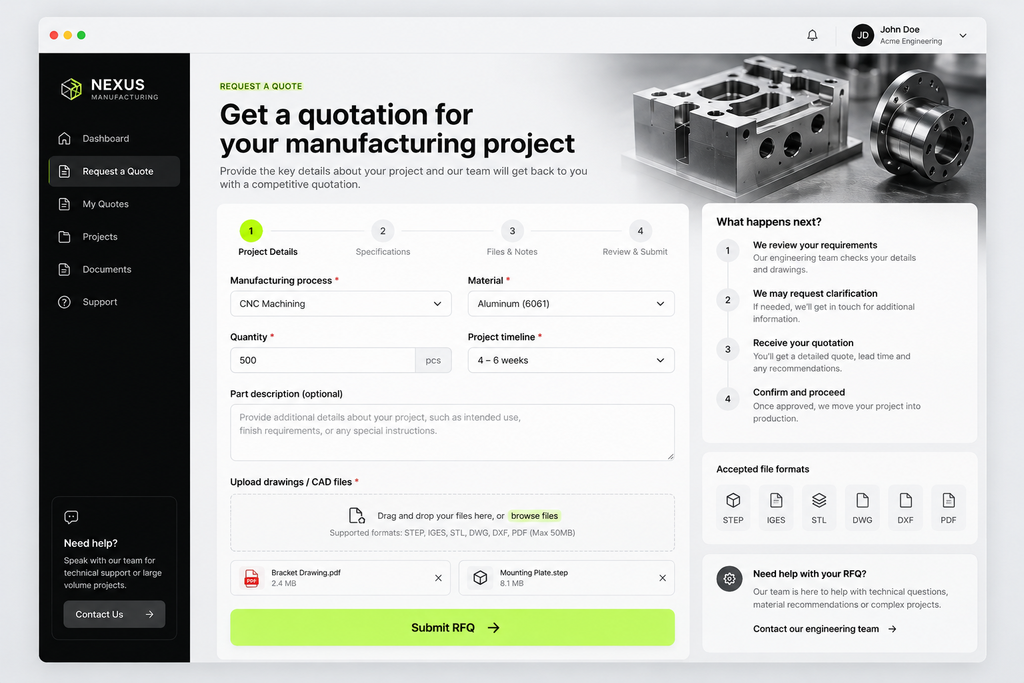
Rather than forcing every prospect through the same general contact form, create a dedicated Request a Quote page accessible from your main navigation, service pages, and relevant capability sections.
The form should capture essential project information, including:
- Project requirements: Manufacturing process, component description, and application.
- Technical specifications: Materials, quantities, tolerances, and relevant standards.
- Supporting documentation: Secure uploads for CAD files, drawings, and specification documents.
- Commercial requirements: Expected delivery dates, production volumes, and purchasing timelines.
- Contact details: Company information and the appropriate technical or procurement contact.
For manufacturers offering multiple services, conditional fields can make the process more efficient.
A customer requesting CNC machining may need different input fields from someone seeking sheet metal fabrication or industrial equipment assembly.
Allow buyers to submit partial information when specifications aren’t finalized. Make clear which information is required for a formal quotation.
After submission, provide confirmation and route the enquiry to the appropriate technical team.
The result is a more organized intake process that supports faster qualification and reduces unnecessary follow-up.
Step 2: Build Capability Pages That Answer Procurement Questions
Before requesting a quotation, serious industrial buyers need evidence that your company can handle their requirements.
A generic services page listing “CNC Machining, Fabrication, and Engineering” provides limited information.
Instead, create dedicated pages for your core manufacturing capabilities.
A strong CNC machining page, for example, should communicate the types of operations supported, machine capabilities, materials handled, achievable tolerances where appropriate, and typical production volumes.
Where applicable, include certifications, inspection equipment, downloadable capability statements, and relevant project examples.
This information serves two purposes.
First, it helps procurement professionals assess technical suitability before contacting your team.
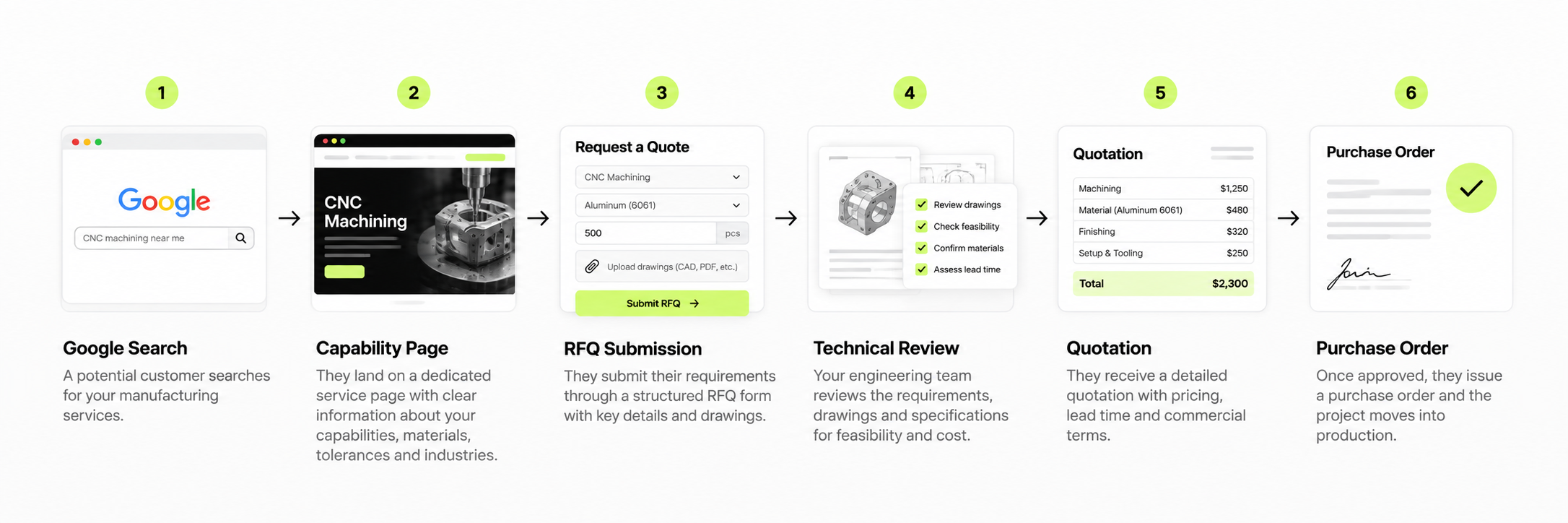
Second, detailed capability pages create opportunities to appear in relevant Google searches.
A buyer searching for “precision CNC machining for stainless steel components” has a more specific requirement than someone searching for “engineering company.”
A well-structured page addressing that capability can provide a stronger match for the buyer’s search intent.
However, visibility depends on several factors, including website quality, search competition, content relevance, and technical SEO.
Each capability page should connect naturally to your RFQ portal, allowing prospective buyers to move directly from technical evaluation to quotation submission.
Step 3: Connect Your RFQ System to a Measurable Sales Pipeline
Generating enquiries is only one part of the process.
Your business also needs a reliable system for receiving, qualifying, tracking, and responding to them.
An RFQ submitted through your website shouldn’t disappear into an unattended email inbox.
Connect submissions to a centralized CRM, quotation management platform, or structured internal workflow.
At minimum, the system should record the enquiry source, submission date, requested service, project requirements, assigned team member, and current quotation status.
Automated acknowledgments can confirm receipt and establish expectations without promising an unrealistic quotation turnaround.
You should also track whether enquiries progress from initial submission to technical review, formal quotation, and ultimately a purchase order.
Useful metrics include:
- RFQ conversion rate: Percentage of relevant website visitors who submit quotation requests.
- Qualified RFQ rate: Percentage of submissions that meet your technical and commercial criteria.
- Response time: Time between receiving an RFQ and providing the first meaningful response.
- Quote-to-order conversion: Percentage of issued quotations that become confirmed orders.
These metrics help distinguish between a website generating activity and one contributing to genuine commercial opportunities.
The Commercial Cost of an Ineffective RFQ Pipeline
Consider a manufacturer pursuing projects with an average contract value of $150,000.
If an improved website and quotation process helps the business secure just one additional contract annually, that represents $150,000 in additional contract value.
That’s a hypothetical illustration, not a guaranteed return. Contract value isn’t equivalent to profit, and actual results depend on margins, buyer demand, competition, and the company’s ability to deliver.
Nevertheless, it demonstrates why RFQ performance deserves management attention.
For industrial manufacturers, the commercial value of improving a website isn’t necessarily measured by thousands of additional visitors.
It’s measured by whether the right buyers can discover the business, evaluate its capabilities, and submit qualified project opportunities.
A manufacturer doesn’t need hundreds of irrelevant enquiries.
It needs a dependable process for converting serious commercial interest into projects its team can realistically deliver.
Your Website Should Reflect the Business You’ve Built
Your manufacturing operation may have evolved considerably over the past decade.
You’ve invested in better machinery, improved production processes, expanded technical capabilities, and established stronger quality controls.
But has your website kept pace?
If prospective buyers encounter outdated service information, unclear technical capabilities, slow-loading pages, and cumbersome quotation forms, they may never discover what your operation can actually deliver.
A high-performing manufacturing website should function as an extension of your commercial infrastructure: communicating capabilities, establishing credibility, capturing technical requirements, and connecting qualified buyers with the right people.
Your next major RFQ shouldn’t be lost because your website made it unnecessarily difficult to get started.
Build a Better RFQ Pipeline With Cruxe Studio
At Cruxe Studio, we design and optimize websites for industrial, engineering, and commercial service businesses that need more than a digital brochure.
From custom manufacturing websites and technical SEO to streamlined quotation forms and ongoing website support, our focus is on making your business easier to discover, evaluate, and contact.
Whether your existing website needs targeted improvements or a complete redesign, the starting point is understanding where your current digital presence may be limiting commercial opportunities.